
Philadelphia:(267) 627-6463
Menu
Philadelphia:(267) 627-6463

Resources

BLOG
Home. About US. BLOG. Expert Guide to a “Snatched” Jawline: How Dr. Tina Ho Achieves Youthful, Sculpted Facial and Jawline Contours

Knowledge for Confident Decisions

Welcome to the professional blog of Dr. Tina Ho, a board-certified plastic surgeon. Here, you will find expert insights into aesthetic and reconstructive procedures, emphasizing patient education and the latest advancements in plastic surgery.

Expert Guide to a “Snatched” Jawline: How Dr. Tina Ho Achieves Youthful, Sculpted Facial and Jawline Contours

In beauty and pop culture slang, a “snatched” jawline refers to a jaw profile that is exceptionally defined, sharp, and taut. It is the antithesis of a soft or undefined lower face.

Visually, a snatched jawline creates a striking, architectural frame for the face. Here is a breakdown of its specific characteristics:

The Right Angle (The Gonial Angle)

The most defining feature is a sharp mandibular angle (the corner of the jaw below the ear). In a “snatched” look, this angle is clearly visible and creates a distinct structural corner rather than a sloping curve. It often approaches a “squared-off” look that signals strong bone structure.

High Definition and Contrast

There is a stark, high-contrast separation between the face and the neck.

  • Shadow Play: Under overhead lighting, a snatched jawline casts a sharp, dark shadow on the neck, emphasizing the protrusion of the bone.
  • No “Double Chin”: The submental area (the area under the chin) is tight and flush against the neck muscles, with no visible fullness or loose skin blurring the transition.

Taut Skin

The term “snatched” implies being pulled tight (like a ponytail). Consequently, the skin along the jawline appears firm and elastic, hugging the bone closely without sagging or jowls.

Projection

A snatched profile usually involves a chin that projects slightly forward or is vertically aligned with the lower lip. This forward projection elongates the jawline, adding to the appearance of sleekness and balance.

A well-defined jawline is a symbol of youth, vitality, and fitness. Whether your goal is to look slimmer, more balanced, or simply boost your confidence, jawline contouring offers a variety of solutions tailored to your unique facial structure. This comprehensive guide explores the causes of jawline concerns and the best treatments available—from non-surgical options to surgical procedures—to help you achieve a strong, attractive jawline.

Achieving a Snatched Jawline with Jawline Contouring

Before diving into the treatment options provided by Dr. Tina Ho, it’s important to identify the root causes affecting your jawline definition. These typically fall into four categories:

  • Skin laxity: Loose, sagging skin that obscures the jawline.
  • Muscle issues: Weak or drooping neck muscles causing neck bands.
  • Fat accumulation: Excess fat under the chin, commonly called a double chin.
  • Skeletal structure: Recessed or underdeveloped chin and jawbone.

Understanding which of these factors impact your appearance helps guide the best course of action.

Skin Laxity: Tightening Loose Skin

Loose skin is a common cause of a poorly defined jawline. Aging, weight fluctuations, and sun damage can reduce skin elasticity, leading to sagging around the jawline and neck. Non-surgical skin tightening treatments are effective solutions, including:

These procedures typically have minimal downtime and are ideal for those seeking gradual improvement without surgery. 

Surgical options for tightening loose skin around the Jawline can produce more dramatic results than their non-surgical counterparts. The most common offered by Dr. Ho would include:

  • Facelift: Surgically lifts and tightens the underlying muscle and connective tissue system, which restores the structural foundation of the lower face. Excess skin is also removed and lifted, resulting in a smooth, sharp contour that hugs the jawbone and eliminates jowls.
  • Neck lift: Tightens and removes excess fat and loose skin from under the chin. This surgical process sharpens the cervicomental angle—the distinct 90-degree corner where the jaw ends, and the neck begins—creating a crisp, high-contrast separation between the face and neck.   This procedure is frequently performed by Dr. Tina Ho in conjunction with facelift. 

Muscle Weakness: The Role of Neck Bands

The platysma muscle runs vertically down the neck and can form visible bands when weakened or lax, contributing to an aged or tired appearance. A surgical neck lift can tighten these muscles and remove excess skin, restoring a smooth and youthful neckline that enhances jawline definition. Botox injections can relax strong platysma muscles to improve neck contour; this procedure is often referred to as a Nefertiti lift. 

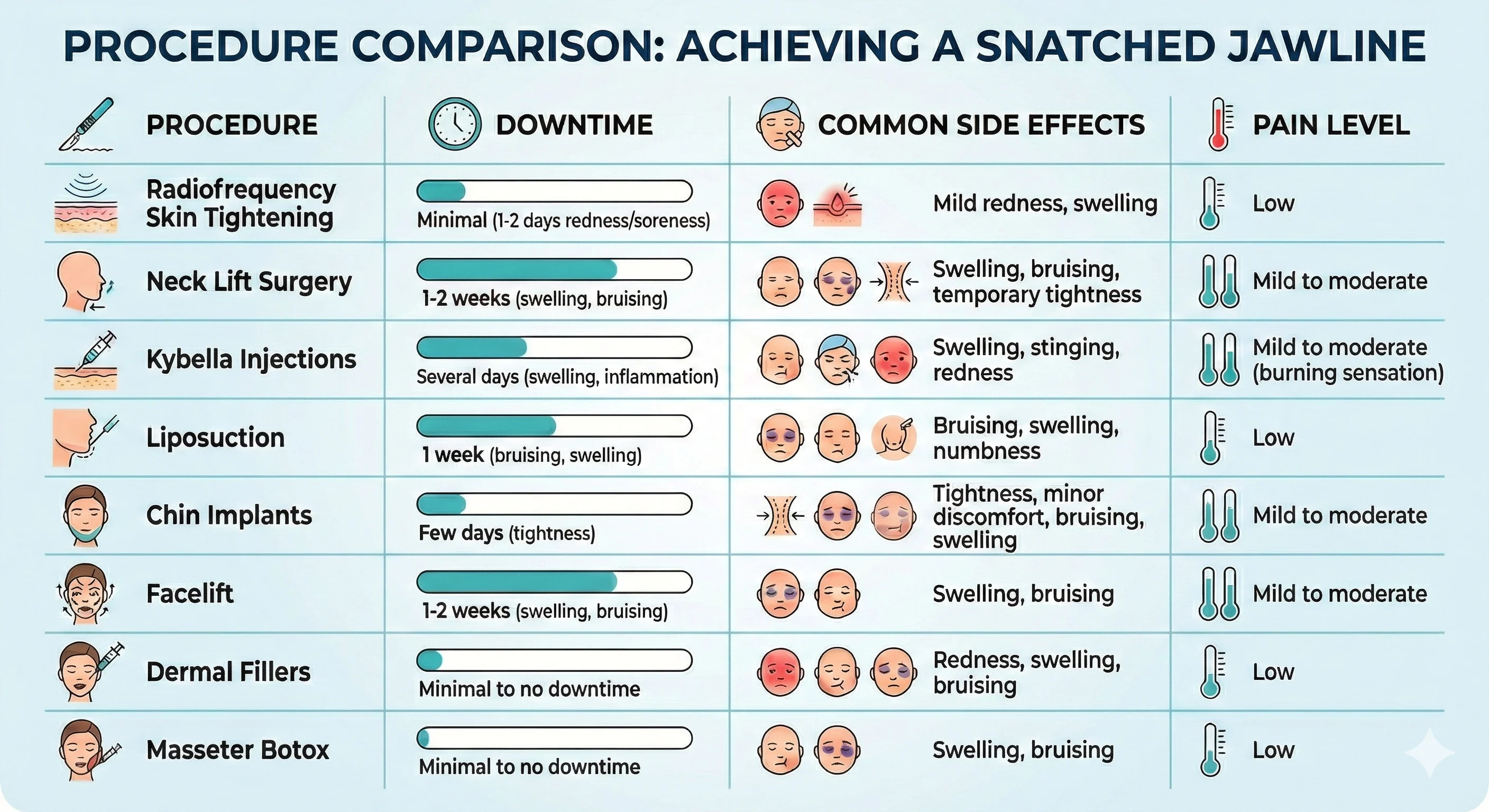
  • Neck lift surgery: Involves lifting and tightening muscles and skin for a contoured jaw and neck. Recovery includes mild swelling and bruising for about a week but typically results in dramatic, long-lasting improvement.

Fat Accumulation: Tackling the Double Chin

Excess fat beneath the chin creates the appearance of a double chin, which masks the jawline. Both non-surgical and surgical treatments are available:

  • Kybella Injections: A non-surgical option that uses a naturally derived enzyme to dissolve fat cells. It may require multiple treatments and cause some swelling and discomfort.
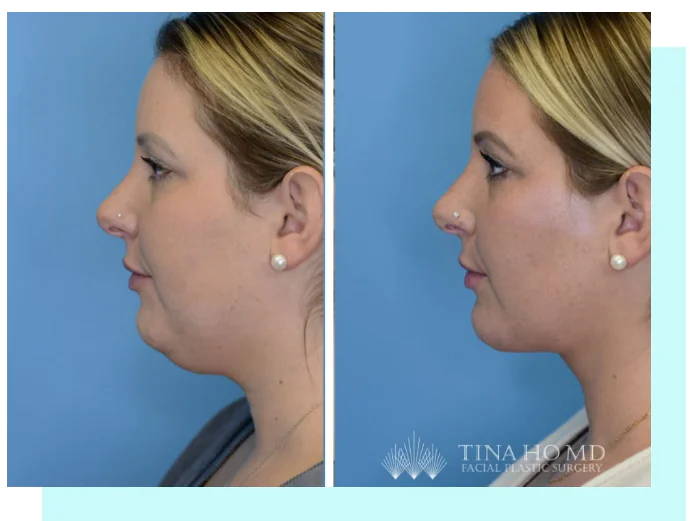
  • Submental liposuction: A surgical method to physically remove fat deposits, providing immediate and noticeable results. This procedure usually involves minor bruising and swelling, but it is an effective way to help restore a snatched jawline.
  • Mini Neck Lift: A surgical procedure that definitively restores jawline and neck contour beyond sculpting of superficial fat. Typically sculpting of deeper neck structures including muscle, fat, and glands are involved. A lax platysma muscle layer can also be tightened during this surgery to further enhance neck definition. 

Skeletal Deficiencies: Enhancing Bone Structure

Sometimes, the jawline appears weak due to underlying bone structure issues—such as a recessed chin or a less prominent jaw angle. To address this, both surgical and non-surgical options exist:

  • Chin Augmentation: Permanent implants inserted through the mouth to project and strengthen the chin. This surgical procedure has a quick recovery and minimal pain.
  • Facial Fillers: Injectable filler options that add volume to the chin and jawline can temporarily contour and enhance the shape without surgery.

Special Considerations: Masseter Muscle and Jawline Shape

Besides skin, fat, muscle, and bone, the masseter muscles—the muscles used for chewing—also influence jawline shape.

  • Hypertrophy (enlargement) of masseters can create a square jaw appearance.
  • Masseter Botox injections can slim oversized masseter muscles by relaxing them, softening the jawline.

Combining Treatments for Optimal Results

Many patients benefit from combining procedures to address multiple factors simultaneously. For example:

  • Chin liposuction for fat removal.
  • Skin tightening treatments to firm loose skin.
  • Muscle tightening via neck lift surgery.
  • Bone augmentation with implants or fillers.

A personalized treatment plan would be discussed during a personal consultation with Dr. Ho based on your anatomy and goals. This is an important first step in the process as it ensures the most natural and effective outcome on the journey to a wonderfully snatched jawline.

Recovery and Aftercare
jawline recovery and aftercare

Recovery times and side effects vary depending on the procedure: Non-surgical treatments generally have quicker recovery and less discomfort, while surgical options provide more dramatic results but require more downtime.

Final Thoughts on Jawline Contouring

Achieving a snatched jawline is possible through a variety of treatments tailored to your unique concerns. Whether you prefer non-surgical options like fillers, Kybella, and microneedling, or surgical approaches such as neck lifts, liposuction, or chin implants, there is a solution for every need.

Consult with a qualified specialist, like Dr. Tina Ho, who can assess your skin, muscles, fat, and bone structure to recommend a customized plan. Combining procedures often yields the best, most natural results that enhance your facial harmony and boost your confidence.

If you are considering jawline contouring, make sure to ask about the benefits, risks, recovery, and maintenance for each option to make an informed decision that suits your lifestyle and aesthetic goals.

Back to Blog

Quick Answers to Common Queries

Frequently Asked Questions

Explore our frequently asked questions for helpful information about Dr. Tina Ho’s facial plastic surgery practice, procedures, and patient care.

By focusing on reshaping structures of the neck and head, facial plastic surgeons are able to make a wide range of modifications to body parts. These alterations can be done to the chin, nose, ears, cheekbones, and neckline. Although many people visit a facial plastic surgeon to make cosmetic adjustments to features they would like to change, these surgeons are also a core part of improving the quality of life of those who suffer from diseases or injuries that could affect their appearance. 

With the help of a facial plastic surgeon, there are many facial customizations available to you. Patients who come to see Dr. Tina Ho, MD, are generally looking for quality cosmetic surgery in Philadelphia that they can trust.

The cost of facial surgery typically varies, and the price you pay depends on the amount of work that needs to be done. Before your surgical procedure, you willl have a thorough consultation with your surgeon to discuss everything you can expect from your operation.

You may also discuss potential cost estimates. Generally, the cost of plastic surgeries can range anywhere from $3,000 to $10,000 or more.

It’s also important to note that your insurance may or may not assist with the procedure. Insurance coverage for facial plastic surgery typically depends on whether the procedures are for medical or cosmetic purposes. In most cases, your insurance will not cover cosmetic procedures such as plastic surgery, but there are payment plans available that can help you chip away at the total cost of your surgery. 

If you are interested in facial plastic surgery, it is essential to fully understand the costs that may be incurred from your procedure before you make the financial commitment. Make sure you speak with your surgeon about what fees you can expect to see and any other important details that may impact how your final cost will be factored. Nevertheless, you may be surprised at the range of fees that can go into plastic surgery, as some operations are much more affordable than others. 
At Tina Ho, MD, Facial Plastic Surgery, we strive to offer affordable pricing and top tier facial plastic surgery for our patients in Philadelphia and beyond.

To be eligible for plastic surgery, a patient must be 18 or older. However, to secure a consultation for a facelift or neck lift, there is no age limit. Individuals from their early twenties into their nineties can enjoy all the benefits a facelift or neck lift procedure has to offer.

It is essential to understand that you should be in good health before pursuing a facelift or neck lift, and this can become more challenging as you age. However, the best age to have a facelift or neck lift is different for each person. When the face and neck start to develop sagging skin, wrinkles, crow’s feet, and other signs of aging, this would be the best time to look into a facelift or neck lift procedure. You also want to consider that getting a facelift or neck lift too early on in life can only be so effective and may deliver minimal results.

The cost of facial surgery typically varies, and the price you pay depends on the amount of work that needs to be done. Before your surgical procedure, you willl have a thorough consultation with your surgeon to discuss everything you can expect from your operation.

You may also discuss potential cost estimates. Generally, the cost of plastic surgeries can range anywhere from $3,000 to $10,000 or more.

It’s also important to note that your insurance may or may not assist with the procedure. Insurance coverage for facial plastic surgery typically depends on whether the procedures are for medical or cosmetic purposes. In most cases, your insurance will not cover cosmetic procedures such as plastic surgery, but there are payment plans available that can help you chip away at the total cost of your surgery. 

If you are interested in facial plastic surgery, it is essential to fully understand the costs that may be incurred from your procedure before you make the financial commitment. Make sure you speak with your surgeon about what fees you can expect to see and any other important details that may impact how your final cost will be factored. Nevertheless, you may be surprised at the range of fees that can go into plastic surgery, as some operations are much more affordable than others. 
At Tina Ho, MD, Facial Plastic Surgery, we strive to offer affordable pricing and top tier facial plastic surgery for our patients in Philadelphia and beyond.

Like most facial plastic surgery operations, costs can generally vary from person to person. A general baseline number you can work off of would be anywhere between $5,000 and $10,000. Then again, this can change drastically based on your location and the surgeon you decide to work with. Some of the costs that are considered for the procedure include anesthesia, medical tests, prescription medication, and surgeon fees. 

A few factors that make up the surgeon’s fee generally pertain to their experience, the type of procedure used, and the actual location of the office itself. Unless the nose job is performed for a medical reason, it is unlikely that insurance will help cover the costs of the operation. This is due to the cosmetic nature of the procedure. However, this does not mean payment plans with the surgeon’s office will not be available to you.

The fee structure for this procedure is a bit unique but also quite affordable when compared with other facial plastic surgeries. Botox is administered in units, and it generally takes around a minimum of 30 to 40 units or higher to achieve the desired results. Pricing may vary based on your surgeon, your location, and the number of units used, but each unit will cost $15. 

It is fairly common for a Botox procedure to incur a total cost of around $300 to $1000 or more. A few factors that play into the total cost include how much surface area is treated, the amount of product that was used, and the surgeon’s fee. Depending on how prominent the wrinkles and fine lines are, this alone could add to the cost, as these factors are directly correlated to how much product may be needed to achieve the results you are looking for.

In the case of Botox versus Juvederm, one product is not necessarily better than the other. However, both serve specific purposes. Botox is best suited for wrinkles that are visible when the face is moving, while Juvederm and other filler brands are the optimal choice for wrinkles that are consistently present when your face is relaxed. You should also know that Juvederm and other fillers tend to be more expensive, but deliver longer-lasting results than Botox. 

Juvederm is the better solution for wrinkles that are consistent and stubborn. In contrast, Botox is seen as a more temporary solution that will need to be repeated more often. Although Juvederm offers results that could last one to two years, it may not always be the best choice based on the current condition of your skin. Overall, a lot of this comes down to personal preference. Both options have their advantages, but Juvederm offers longer term results at a higher cost per treatment.

For those who are looking to modify the shape of their face, jawline contouring is an excellent solution, as the results can range from minimal to much more dramatic. As with any cosmetic procedure, it is a sensitive operation that requires a lot of discussion and planning beforehand. Jawline contouring procedures may be non-surgical, surgical, or both. 

A few key points surround the purpose of jawline contouring, as it aims to improve facial symmetry, proportionality, and overall youthfulness. Downtime after the procedure is relatively minimal, but it is possible to experience some bruising and swelling during recovery. Jawline contouring also includes the chin, and can help with reducing jowls, eliminating double chin features, and delivering a refined front and side profile.

Jawline contouring procedures can be relatively affordable compared with many other procedures. A jawline contouring surgery may cost roughly between $3,000 and $10,000 or more, depending on the work required. Filler starts at $800/syringe, and a minimum 2-4 syringes or more may be needed for adequate results (package specials start at $3000). Jawline contouring procedures are multi-faceted and have boosted the confidence of every one of Dr. Tina Ho’s patients.

You can expect the type of procedure and anesthesia that is chosen to also contribute to the overall cost. Unless the surgery is being performed for medical reasons, your insurance more than likely will not opt to cover the procedure. There are a number of materials that may be utilized in jawline contouring procedures, and these can vary based on the specific procedure used. Materials could include neurotoxins, fillers, and implants.